Posts

Hospices in Las Vegas

Image
Hospices in Las Vegas NV offer many services to their patients. In addition to offering assistance with life support services, hospice provides the basic care that can be life saving. The majority of hospices in Las Vegas NV have a full staff of physicians as well as a number of nurses and support staff to administer both medical and non-medical services to their families. Most of them also have private rooms, which are equipped for the comfort of the terminally ill and their families. While many people equate hospitals with a certain level of clinical care, hospices have a completely different service philosophy. Many provide personalized home care services to their patients and are more interested in understanding their individual needs and providing compassionate assistance to alleviate their suffering. Other services that are offered by hospices in Las Vegas are respite care, counseling, and treatment for alcohol and drug abuse. Hospice is also becoming a popular option for the eld...

which of the following is a common barrier to hospice care?

"Which of the following is a common barrier to hospice care?" That is the question that I posed to one of my colleagues at my Alma mater and here is what she said: "The truth is that nobody wants to die - nobody, in fact. The reason we're given hospice care is so we can be treated to comfort while we are still living." That is a very wise choice, in my opinion, and it certainly I do not dispute her assessment. However, the reality is that many people do not understand exactly what hospice care is all about and, as such, they are often concerned or frightened by the prospect of not receiving any more aid once they are nearing the end of their days. There is no doubt that fear of end-of-life situations can drive some people insane and, to my mind, it is absolutely imperative that the medical community - those who are charged with looking after terminally ill patients - do all that they can to minimize this type of fear in order to ensure that patients receive only...

Best Hospice Care

Image
 Medicare is a federal program which provides coverage for certain specific medical expenses. There are many different types of expenses covered by Medicare, including home health care, adult day care, and respite care. To be eligible for hospice care within Medicare, an individual must fulfill the following criteria: They must be enrolled in a hospital or residential care facility for at least six months; they must be expected to live at least six months; their condition is terminal and they cannot have a natural death. A patient may also choose to enroll in a palliative care program for patients nearing the end-of-life stage. A non-medical professional who is board certified in hospice care is allowed to administer the hospice care. As with any medical treatment, there are both pros and cons to hospice care. One of the main benefits to using this types of hospice care is that a patient is receiving medical treatment from a doctor who is intimately familiar with their medical his...

The Growing Industry of Hospice in Nevada

Image
 When deciding where to go for hospice care, Nevada is among the top states in the U.S. This state has some of the best hospice facilities available and has seen a substantial increase in applications over the last few years. Because hospice is available so widely in Nevada, it is one of the few states that allows families to both choose and combine their care plans from a large number of qualified providers who accept Medicare. It is also one of the few states that offers payment options for families, including those with supplemental security income (SSI) or Medicaid. Although there are other types of care that families in Nevada can choose from, particularly in the areas of palliative care and holistic care, the overwhelming majority of Nevada hospice providers are voluntary. Care at hospice is provided through hospitals or homes that are certified to provide hospice care. This care is not usually covered by any Medicare or other insurance plans, nor will it be billed as a medi...

difference between hospice and nursing home

Image
The difference between hospice and nursing home can be a confusing one for many people who may be in the midst of a tough decision regarding the type of medical care to provide for a loved one. Both of these options offer very different types of care. One is non-medical care, while the other offers medical care. The main difference between hospice and nursing home lies in the manner in which the care is provided. While the primary difference is in the manner in which the care is provided, there are also other important differences as well. The primary difference between hospice and nursing home rests in the manner in which they provide the care. Hospice provides palliative care, which essentially means that the focus of the organization is to ensure that the patients remain comfortable and that they receive all the care that is necessary under the circumstances. Whereas, on the other hand, nursing homes primarily focus on providing intensive care to severely ill people, including t...

What Is Hospice and Palliative Care?

Image
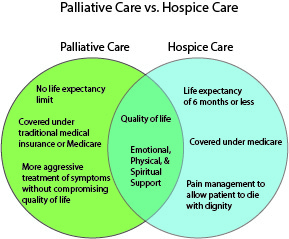
When someone in the Las Vegas area has been diagnosed with cancer or other life-threatening diseases, they may understandably need more than hospice care, or even life support, in order to improve their quality of life. While it's true that many patients in need of both care and palliative services find solace at a hospice facility, there are also many others whose conditions require them to focus primarily on alleviating symptoms and slowing the disease process rather than focusing on prevention, and it's for these individuals that palliative care can provide an extra measure of comfort. Palliative services, while often less intensive than hospice, do not depend on outcome and are available in conjunction with chemotherapy treatment. Patients who do not have access to this measure of medical intervention would never likely qualify for hospice assistance. Only in the latter stages of terminal illness, when death is imminent and the individual no longer requires ongoing curative...